Bra Size Calculator – Find Your Perfect Fit | Measure Accurately
Your Bra Size:
Bra Size Calculator — Find Your Perfect Fit
Ana bought a bra online she liked the look of. The band rode up, the cups gaped, and straps slipped. Frustrated, she visited a small lingerie shop. The fitter measured her and said, “You’re not the same size in every brand — but here’s the size that will actually support you.” Ana left with a bra that felt like it belonged on her.
That’s the goal of a good bra-size calculator: give you the number the fitter would use — a starting point that gets you comfortable, supported and confident.
What this is
A bra size has two parts:
- Band size (number) — the measurement under your bust that gives the support.
- Cup size (letter) — the difference between your bust (fullest part) and your band; it represents breast volume relative to that band.
A reliable bra-size calculator turns two simple measurements (underbust and bust), usually entered in cm, into the band number and cup letter in the sizing system you prefer (US/UK/EU/AU). It’s a starting point — because fit can vary by brand, style and body shape.
Why it matters
- Support & comfort: A correct band carries most of the weight; an ill-fitting band causes back, shoulder or posture issues.
- Shape & appearance: The right cup keeps the breast tissue in the cup (no spillage, no gaping).
- Health: A properly fitted bra reduces rubbing, shoulder strain and poor posture.
- Confidence: Clothes hang better; you feel more comfortable and secure.
How to measure
- Wear a non-padded bra (or nothing) and stand relaxed.
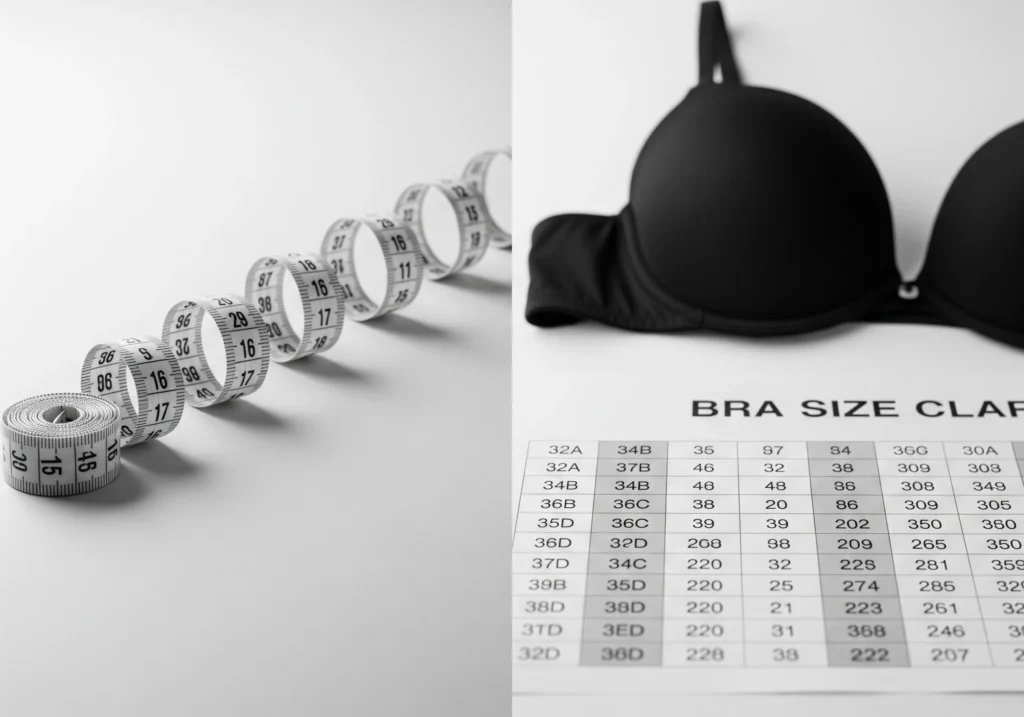
- Underbust (band) — measure snugly: wrap a soft tape around the ribcage right under the bust, level and snug. Record in cm.
- Bust — measure at the fullest point: wrap the tape around the fullest part of the breasts, level around the back. Record in cm.
- Use the calculator: enter Underbust (cm) and Bust (cm). The calculator converts to inches and applies the sizing rules below, then gives band number and cup letter.
- Try the recommended size — then do a fit check (band parallel, straps not doing the work, no quad-boob or gaping, center panel lies flat).
The formula
A. Convert cm → inches (if needed)
inches = cm ÷ 2.54
B. Band size (recommended modern approach)
- Convert underbust cm → underbust inches.
- Round the underbust in inches to the nearest whole inch.
- Because manufacturers usually make even band sizes (30, 32, 34…), if the rounded number is odd, round to the nearest even (or add 1 to get an even).
- Example: 31 in → 32 band.
(Notes: older methods added +4 or +5 inches; modern fitters typically use the snug underbust directly—this avoids overestimating band size.)
- Example: 31 in → 32 band.
C. Cup size (difference method)
- Convert bust cm → bust inches.
- difference = bust_inches − band_inches
- Map the difference (rounded to nearest whole inch) to a cup letter:
| Difference (inches) | Cup (US/UK typical) |
| 0 | AA |
| 1 | A |
| 2 | B |
| 3 | C |
| 4 | D |
| 5 | DD / E |
| 6 | DDD / F |
| 7 | G |
| 8 | H |
| 9 | I, and so on (brands vary) |
(Official cup mappings and examples appear in many professional fitting guides.)
D. Final size = Band number + Cup letter
- Example: Band 34 + difference of 3 inches → 34C.
Worked example
- Underbust = 78 cm
- Bust = 95 cm
Steps:
- Convert: underbust_in = 78 ÷ 2.54 ≈ 30.7 in → round to 31 in → make even → 32 band.
- bust_in = 95 ÷ 2.54 ≈ 37.4 in.
- difference = 37.4 − 32 = 5.4 in → round to 5 in → cup = DD / E.
Result ≈ 32E (US)/32DD (some listings).
(Remember: rounding choices can shift a cup letter; use the number as a strong starting point and then try bras to confirm.)
Sister sizes — why they matter
Sister sizes are bras with the same cup volume but different band numbers — useful when a band is too tight/loose but cup volume is right.
- Example: 34C (cup volume) = 36B = 32D (same cup volume, different band).
If the band feels too tight on 34C, try 36B; if the band is loose, try 32D. This trick allows small adjustments without changing cup volume. (Concept used by fitters.)
How the online calculator works
- You enter Underbust (cm) and Bust (cm).
- Choose a sizing system (US/UK/EU/AUS) — the calculator uses different band conventions if needed.
- The tool converts cm → inches and computes band and cup using the method above.
- It outputs a suggested size in the chosen system and may show sister sizes and equivalent sizes in other systems.
- It also shows measurement tips and a quick fit checklist so you know what to try next.
(If the calculator offers “leaning” or “lying” bust measures, those can help with fuller/pendulous breasts — they estimate maximum volume and improve cup accuracy.)