Epoch Time Converter | Unix Timestamp Tool
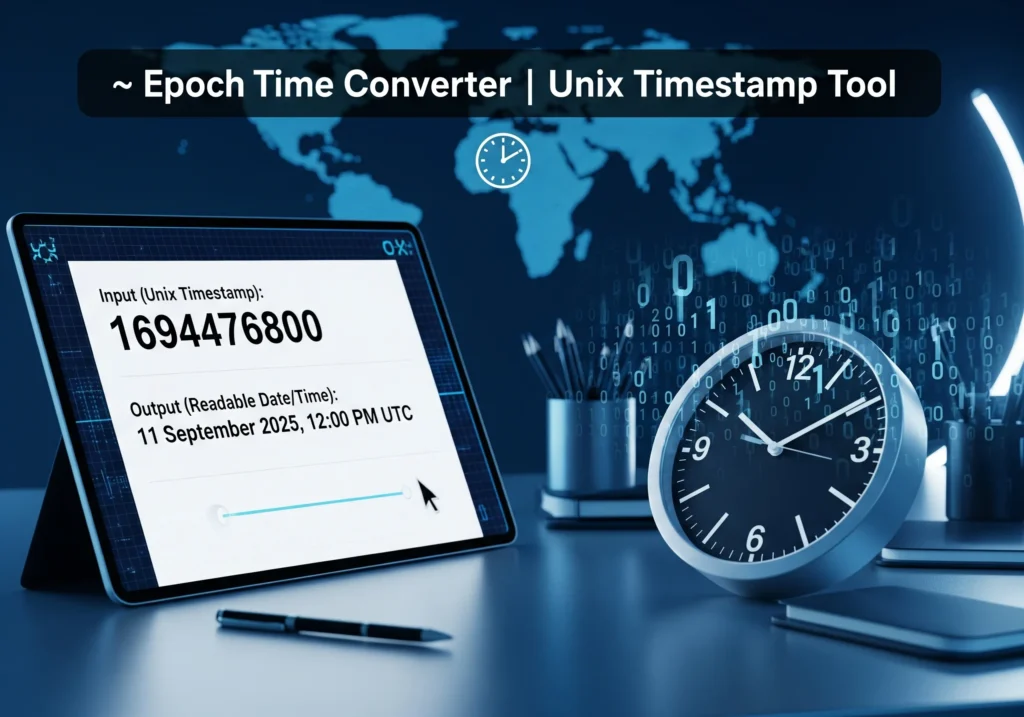
⏱️ Epoch Time Converter | Unix Timestamp Tool
Easily convert between human-readable date and Unix timestamp (epoch time).
Current Unix Timestamp:
📅 Date → Unix Timestamp
🕒 Unix Timestamp → Date
Epoch Time Converter | Unix Timestamp Tool
Have you ever come across a long string of numbers like 1694275200 and wondered what it means? At first glance, it looks like random digits. In reality, it’s not random at all — it’s epoch time (also called a Unix timestamp). An Epoch Time Converter helps you take these numbers and instantly translate them into normal, human-readable dates and times. The reverse works too: you can take a standard date and convert it into epoch time.
This tool is especially useful for developers, database managers, and anyone who deals with time formats in technology. Let’s explore what it is, why it matters, and how to use the converter step by step.
What Is Epoch Time?
Epoch time is a simple way computers keep track of dates and times. Instead of storing “9 September 2025, 3:00 PM,” computers use a single number: the seconds that have passed since January 1, 1970, 00:00:00 UTC (the “Unix epoch”).
For example:
- 0 = January 1, 1970, 00:00:00 UTC
- 1,000,000,000 = September 9, 2001, 01:46:40 UTC
- 1694275200 = September 9, 2023, 00:00:00 UTC
Because it’s just a number, it’s easy for computers to store, compare, and calculate time differences.
Why Is This Important?
- Programming & Databases: Many systems save timestamps in epoch format for simplicity.
- Cross-Platform Consistency: Epoch avoids confusion between time zones, formats (MM/DD/YYYY vs DD/MM/YYYY), and daylight savings.
- Time Math: Adding or subtracting seconds is easier than manipulating strings like “August 10, 2025, 5:30 PM.”
- Everyday Use: If you’re checking server logs, APIs, or blockchain data, you’ll often see epoch time.
Without a converter, reading these numbers can be frustrating.
The Formula Behind Epoch Conversion
- From Epoch to Human Date/Time:
- Take the number of seconds since Jan 1, 1970 (UTC).
- Convert to days, hours, minutes, and seconds.
- Apply time zone if needed.
- Take the number of seconds since Jan 1, 1970 (UTC).
- Example: 1694275200 ÷ (60 × 60 × 24) ≈ 19619 days since epoch → 9 Sept 2023.
- From Human Date/Time to Epoch:
- Start from Jan 1, 1970, 00:00 UTC.
- Count total seconds up to the given date/time.
- Output as an integer (e.g., 1736467200 for Jan 10, 2025, 00:00 UTC).
- Start from Jan 1, 1970, 00:00 UTC.
The calculator handles all this instantly, so you don’t need to do the math.
How the Converter Works (Step by Step)
- Input an epoch timestamp.
- Example: 1700000000.
- Example: 1700000000.
- Click convert.
- The tool translates it into a human date: “November 14, 2023, 22:13:20 UTC.”
- The tool translates it into a human date: “November 14, 2023, 22:13:20 UTC.”
- Or, enter a date/time.
- Example: “March 1, 2024, 12:00 PM.”
- Example: “March 1, 2024, 12:00 PM.”
- Convert back.
- The tool outputs: 1709294400.
- The tool outputs: 1709294400.
- Results displayed instantly.
- Easy to copy, paste, or use in your project.
- Easy to copy, paste, or use in your project.