Daily Energy Requirements Calculator | Calculate Your Calorie Needs
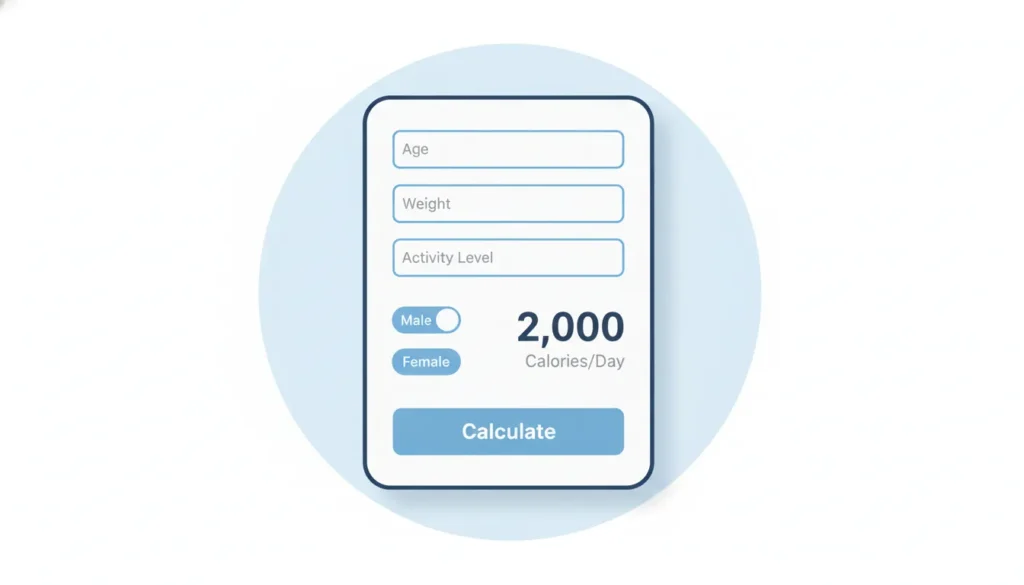
Daily Energy Requirements Calculator
Calculate your BMR and TDEE based on the Mifflin-St Jeor Equation.
Your Daily Energy Requirements
Basal Metabolic Rate (BMR)
0 Calories
Calories your body needs at complete rest.
Total Daily Energy Expenditure (TDEE)
0 Calories
Calories you burn including activity.
Calories for Your Goal
0 Calories
Based on your selected goal.
Daily Energy Requirements Calculator | Calculate Your Calorie Needs
Knowing your daily energy (calorie) needs is essential for weight management, performance, recovery, and clinical nutrition planning. The Daily Energy Requirements Calculator estimates your total daily energy expenditure (TDEE) by combining a resting metabolic rate (RMR/BMR) equation with an activity multiplier and optional adjustments for weight goals or clinical stressors. Use it to plan calories for weight maintenance, loss, gain, or clinical nutrition prescriptions.
Why Estimating Energy Needs Matters
- Weight management: Prescribe calorie targets for maintenance, weight loss, or weight gain.
- Clinical care: Support recovery and healing by meeting increased energy demands in illness, surgery, or malnutrition.
- Performance: Optimize athletic training and recovery with appropriate energy availability.
- Monitoring: Track intake vs requirement to prevent unintentional weight changes and nutrient deficiencies.
Who This Calculator Is For
Adults and older adolescents seeking an evidence-based estimate of daily calorie needs. For critically ill patients, infants, young children, or highly specialized athletic programs, use condition-specific guidance and specialist input.
Key Parameters Used
- Age (years)
- Sex (male / female)
- Weight (kg or lb)
- Height (cm or in)
- Activity level (sedentary → very active)
- Weight goal (maintain, lose, gain) — optional caloric adjustment
- Clinical stress/multipliers (e.g., mild/moderate/severe illness) — optional
Primary Equations Used (Conceptual)
Several validated equations estimate resting energy expenditure (RMR/BMR). A commonly used and accurate adult equation is Mifflin–St Jeor:
Mifflin–St Jeor (RMR in kcal/day):
For men: RMR = 10 × weight(kg) + 6.25 × height(cm) − 5 × age(years) + 5
For women: RMR = 10 × weight(kg) + 6.25 × height(cm) − 5 × age(years) − 161
After calculating RMR, multiply by an activity factor to get Total Daily Energy Expenditure (TDEE):
TDEE = RMR × Activity Factor
Typical Activity Factors
- Sedentary: little or no exercise —
× 1.2 - Lightly active: light exercise/sports 1–3 days/week —
× 1.375 - Moderately active: moderate exercise/sports 3–5 days/week —
× 1.55 - Very active: hard exercise/sports 6–7 days/week —
× 1.725 - Extra active: very hard exercise & physical job or training twice daily —
× 1.9
Adjustments for Goals and Clinical States
- Weight loss: Common deficit = 500 kcal/day for ~0.45 kg (1 lb) loss/week (adjust individually and monitor). Do not go below safe minimums without clinician supervision.
- Weight gain: Common surplus = 250–500 kcal/day for gradual gain.
- Clinical stress or illness: apply appropriate stress/injury multipliers (e.g., 1.1–1.5) based on severity and clinical guidance.
- Refeeding/malnutrition: start conservatively and follow protocol to avoid refeeding complications.
Step-by-Step Example
Problem: Estimate daily calorie needs for a 30-year-old woman, 70 kg, 165 cm, moderately active, goal: maintain weight.
Step 1 — Calculate RMR (Mifflin–St Jeor):
RMR = 10 × 70 + 6.25 × 165 − 5 × 30 − 161
RMR = 700 + 1031.25 − 150 − 161 = 1420.25 kcal/day (approx. 1420 kcal)
Step 2 — Apply activity factor (moderately active ×1.55):
TDEE = 1420 × 1.55 ≈ 2,201 kcal/day
Step 3 — Adjust for goal (maintain):
Recommended daily calories ≈ 2,200 kcal/day.
How the Calculator Works (User Flow)
- Enter age, sex, weight, height, and choose activity level.
- Select a goal: maintain, lose (choose desired rate), or gain weight (choose desired rate).
- Optionally select clinical modifiers (illness, pregnancy, lactation) that alter multipliers.
- Click “Calculate” — the tool computes RMR (Mifflin–St Jeor), multiplies by activity factor, and applies goal adjustments to return daily calorie targets.
- Optional outputs: macronutrient breakdown suggestions (protein/fat/carbohydrate ranges), sample meal calorie splits, printable plan.
Suggested Macronutrient Guidance (General)
- Protein: 0.8–1.2 g/kg/day for healthy adults; 1.2–2.0 g/kg/day for athletes, recovery, or catabolic states (adjust clinically).
- Fat: 20–35% of total calories (ensure essential fatty acids).
- Carbohydrate: Fill remaining calories after protein and fat (45–65% typical range for many adults; adjust for goals/sports).
Limitations & Important Considerations
- Equations provide estimates — individual energy needs vary with genetics, thermic effect of food, non-exercise activity thermogenesis (NEAT), and metabolic adaptations.
- For obese individuals, choice of weight (actual vs ideal) can affect estimates; clinicians may use adjusted approaches.
- In critical illness, burns, or severe trauma, use specialized clinical equations and dietitian input.
- Track weight and clinical outcomes and revise calorie targets as needed — calculations are starting points, not fixed prescriptions.
- For athletes, periodized intake (training vs rest days) may be required rather than a single daily value.
Stepwise Example — Weight Loss Scenario
Using the previous example (TDEE ≈ 2,201 kcal/day):
– Moderate weight loss target: 2,201 − 500 = 1,701 kcal/day (~0.45 kg / 1 lb per week estimated).
– Monitor progress and adjust every 2–4 weeks; larger deficits increase the risk of lean mass loss and metabolic adaptation.
FAQs – Daily Energy Requirements Calculator
1. Which equation is best?
Mifflin–St Jeor is widely used and validated in many adult populations; other equations (Harris–Benedict, WHO/FAO) are available. Choose the one recommended by your clinic or dietitian.
2. Should I use actual or ideal body weight?
Use actual body weight for most healthy adults. For obesity or extremes of body composition, clinicians may prefer ideal or adjusted body weight — follow local guidance.
3. How accurate is TDEE?
Typical prediction error is ±10–20% for equations. Use observed weight trends and adjust targets accordingly.
4. Can this calculator be used for pregnancy?
Pregnancy increases energy needs; use pregnancy-specific guidance (additional kcal by trimester) rather than standard multipliers.
5. How quickly should I change calorie targets?
Re-evaluate every 2–4 weeks based on weight trend, performance, and clinical status. Avoid overly rapid changes without supervision.
6. What if I’m an athlete?
Athletes often need higher energy and altered macronutrient ratios. Use sports nutrition guidance and consider periodized intake (training vs rest).
7. Is losing 500 kcal/day safe?
For many adults, a 500 kcal/day deficit is a common, generally safe starting point for gradual weight loss. Do not drop below minimum calorie recommendations; seek professional advice for larger deficits.
8. Does age affect calorie needs?
Yes — metabolic rate generally declines with age, which the equation accounts for via the age term.
9. Can I get a meal plan from this?
The calculator can provide sample calorie-distributed meal templates, but individualized meal plans should come from a registered dietitian for medical conditions or specialized goals.
10. Is this medical or nutritional advice?
No. This tool provides an estimate for educational and planning purposes. For personalised medical nutrition therapy or clinical conditions, consult a registered dietitian or clinician.
Quick Disclaimer
The Daily Energy Requirements Calculator provides evidence-based estimates only. It does not replace personalised medical or dietary advice. For complex clinical situations, infants, children, pregnant or lactating people, or critical illness, consult qualified healthcare professionals.