Pythagorean Theorem Calculator – Find Triangle Sides Easily
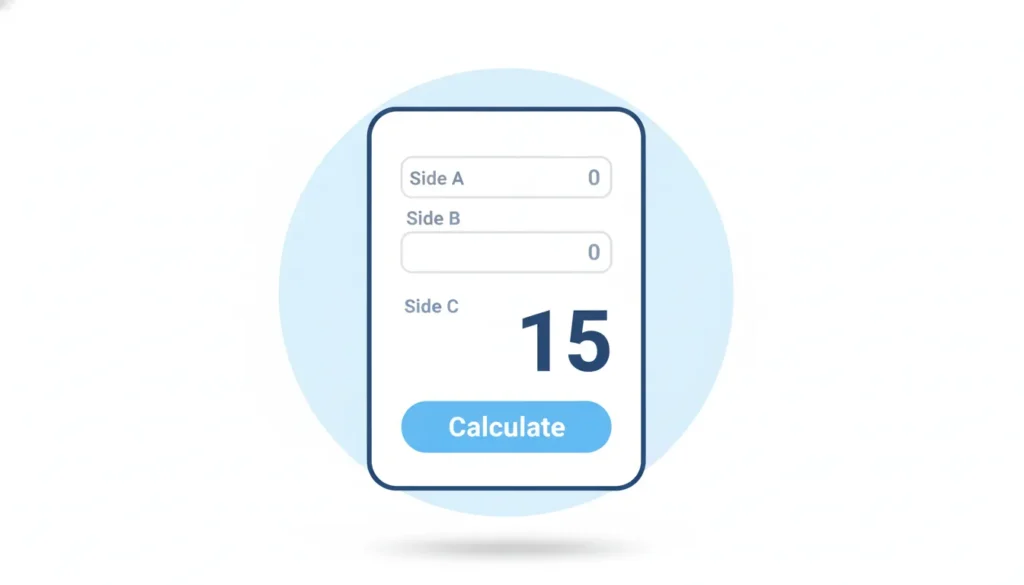
Pythagorean Theorem Calculator
Find the Unknown Side
Pythagorean Theorem Calculator – Find Triangle Sides Easily
The Pythagorean Theorem Calculator quickly computes the length of a side in a right-angled triangle using the Pythagorean theorem. For any right triangle with legs a and b, and hypotenuse c, the theorem states: c² = a² + b². This tool can solve for c (the hypotenuse) or for an unknown leg (a or b) when the other two sides are known.
Why Use This Calculator
- Fast & accurate: Instantly find missing side lengths for geometry, carpentry, navigation, or basic engineering tasks.
- Educational: Helps students learn and check homework involving right triangles.
- Practical: Useful for layout, construction, roof pitch, and determining diagonal distances.
Key Parameters
- Side a (one leg)
- Side b (other leg)
- Side c (hypotenuse — side opposite the right angle)
- Specify which side is unknown (a, b, or c)
- Units (meters, centimeters, inches, feet — keep inputs in the same unit)
Formulas
Hypotenuse (c) given legs a and b:
c = √(a² + b²)
Leg (a) given hypotenuse c and leg b:
a = √(c² − b²)
Leg (b) given hypotenuse c and leg a:
b = √(c² − a²)
Step-by-Step Example 1 — Find Hypotenuse
Problem: Find the hypotenuse when a = 3 units and b = 4 units.
Step 1: Apply the formula: c = √(3² + 4²) = √(9 + 16) = √25 = 5 units.
Step-by-Step Example 2 — Find a Missing Leg
Problem: Given hypotenuse c = 13 units and one leg b = 5 units, find leg a.
Step 1: Apply the formula: a = √(13² − 5²) = √(169 − 25) = √144 = 12 units.
How the Calculator Works (User Flow)
- Select which side is unknown: a, b, or c.
- Enter the two known side lengths in the same unit system.
- Click “Calculate” — the tool applies the appropriate Pythagorean formula and returns the missing side length with the same units.
- Optional: display step-by-step calculation and check whether the inputs form a valid right triangle (for example, c must be greater than both a and b when solving for a leg).
Input Validation & Notes
- All inputs must be non-negative numbers. Zero values are valid only where geometrically appropriate.
- When solving for a leg (a or b), ensure the supplied hypotenuse c is strictly greater than the known leg — otherwise the calculation under the square root becomes negative and the result is not real.
- Maintain consistent units for both inputs (e.g., both in cm or both in inches). The output uses the same unit.
- Round results appropriately depending on required precision (for example, two decimal places for practical measurements).
Practical Applications
- Measuring diagonal lengths for carpentry or tiling.
- Verifying right angles in construction (3–4–5 triangles are commonly used).
- Computing distances on maps or between coordinates in orthogonal layouts.
- Basic robotics and CAD geometry checks.
Limitations
- This calculator applies only to right-angled triangles. Do not use it for non-right triangles.
- It does not compute angles; use trigonometric functions (sine, cosine, tangent) if angle measures are required.
- Floating-point rounding may introduce very small numerical errors for extreme values; verify with appropriate precision when necessary.
FAQs – Pythagorean Theorem Calculator
1. Can I enter decimals?
Yes — decimal values are accepted and the result will be computed with floating-point precision.
2. What if c ≤ known leg when solving for a leg?
If c ≤ known leg, the expression under the square root (c² − known_leg²) is zero or negative. Zero yields a degenerate (zero) leg; negative indicates invalid inputs (no real triangle). Check your inputs.
3. Can this find area or perimeter?
Not directly — but once you have all three sides, area = (1/2) × a × b for a right triangle, and perimeter = a + b + c.
4. Is this useful for 3D distance?
You can combine Pythagorean calculations: compute horizontal distance with one application and then apply again with vertical height to get a 3D straight-line distance.
5. How accurate is the result?
Accuracy depends on input precision. Use appropriate rounding for your application (e.g., engineering vs classroom work).
6. Does it check for right-angle validity?
The calculator assumes the triangle is right-angled. You can verify by checking whether a² + b² ≈ c² after computing all sides (within rounding tolerance).
7. Can it help with angle calculation?
Not directly, but you can compute angles via inverse trigonometric functions once sides are known (for example, angle opposite a = arcsin(a/c) or arctan(a/b)).
8. Are units converted automatically?
No — enter both known sides in the same units. Convert beforehand or provide unit conversion functionality if required.
9. What precision should I use?
For most practical tasks, two decimal places are sufficient. For scientific work, increase precision accordingly.
10. Is this safe for structural calculations?
Use caution: while geometry is exact, structural engineering requires safety factors and material properties beyond simple side lengths. Consult a qualified engineer for load-bearing designs.
Quick Disclaimer
This Pythagorean Theorem Calculator is intended for educational and general-purpose calculations only. It does not replace professional engineering or architectural judgment. Always confirm critical measurements and validate units and inputs before using results in construction or safety-critical contexts.