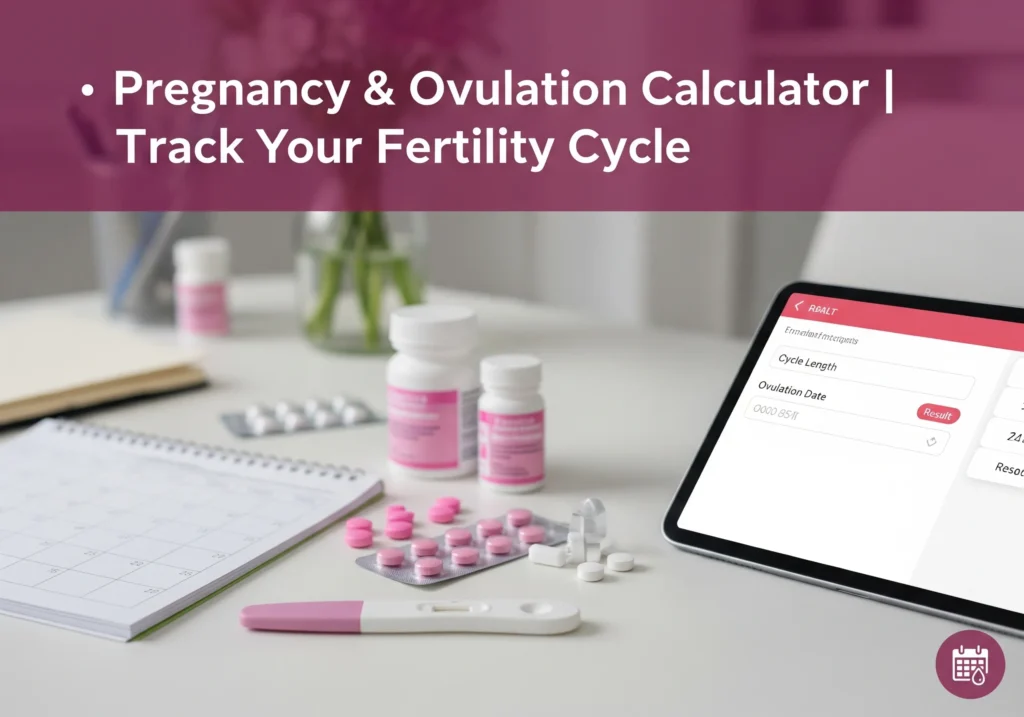
Pregnancy & Ovulation Calculator | Track Your Fertility Cycle
Pregnancy & Ovulation Calculator
Track your fertility cycle, predict ovulation, and calculate your due date
Pregnancy & Ovulation Calculator | Track Your Fertility Cycle
Emma had been trying to conceive for a few months. She noticed her cycle was regular, but she wasn’t sure when exactly she was ovulating or which days were her most fertile. She tried counting days on a calendar, but it felt confusing.
That’s when she discovered the Pregnancy & Ovulation Calculator — a simple tool that showed her next ovulation date, fertile window, next period, and even the best time to take a pregnancy test.
This tool takes the guesswork out of family planning and replaces it with clarity
What Is This Calculator?
The Pregnancy & Ovulation Calculator helps women:
- Predict their ovulation day (the release of an egg).
- Identify their fertile window (the 5–6 days when pregnancy is most likely).
- Estimate their next period date.
- Suggest the earliest date for a pregnancy test.
- If conception occurs, estimate the due date.
It uses simple inputs like your last menstrual period (LMP), average cycle length, and luteal phase length.
Why Is It Important?
- For pregnancy planning: Increases chances of conceiving naturally.
- For cycle tracking: Helps understand your body’s rhythm.
- For early detection: Guides when to test for pregnancy.
- For reassurance: Reduces stress by giving clear dates instead of guesswork.
Knowing your cycle gives you control and confidence over your reproductive health.
The Formula Behind the Calculator
The calculation is based on the menstrual cycle:
- Ovulation Date = LMP + (Cycle Length – Luteal Phase)
- Fertile Window = 5 days before ovulation + ovulation day
- Next Period = LMP + Cycle Length
- Pregnancy Test Date = Ovulation Date + 12–14 days
👉 Example:
- LMP: Jan 1
- Cycle Length: 28 days
- Luteal Phase: 14 days
Ovulation = Jan 1 + (28 – 14) = Jan 15
Fertile Window = Jan 10–15
Next Period = Jan 29
Earliest Pregnancy Test = Jan 27
Step-by-Step: How the Calculator Works
- Enter LMP (first day of your last period).
- Enter your average cycle length (commonly 28 days, but can be 21–35).
- Enter luteal phase length (default is 14 days unless you know otherwise).
- (Optional) Enter a conception date if you already know it.
- Press calculate.
- The tool shows:
- Next ovulation date.
- Fertile window (best days to try).
- Next expected period.
- Best time to take a pregnancy test.
- Next ovulation date.