ASCVD Risk Calculator – Evaluate Cardiovascular Risk Instantly
ASCVD Risk Calculator
ASCVD Risk Calculator – Evaluate Cardiovascular Risk Instantly
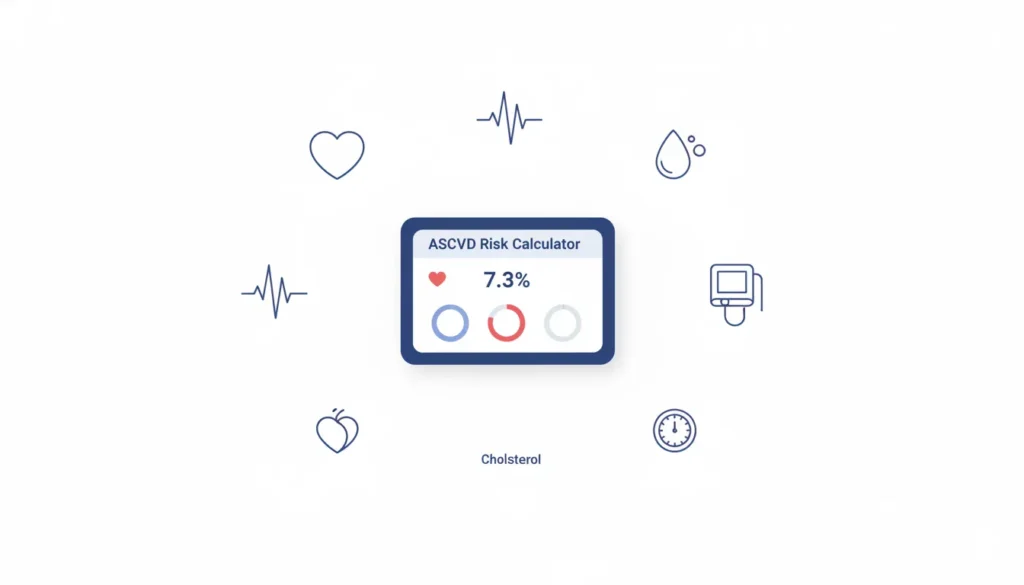
Atherosclerotic cardiovascular disease (ASCVD) — which includes heart attack, stroke, and coronary death — is a leading cause of illness and death worldwide. The ASCVD Risk Calculator provides an evidence-based estimate of a person’s 10-year risk of a first ASCVD event using the Pooled Cohort Equations. This helps clinicians and individuals make informed decisions about lifestyle changes and preventive therapies such as statins or blood-pressure treatment.
Why Risk Assessment Matters
- Guides prevention: Risk estimates inform whether to start medications (for example, statins) in people without prior cardiovascular disease.
- Targets interventions: Helps prioritise lifestyle changes (smoking cessation, diet, exercise) for those who will benefit most.
- Shared decision-making: Provides a concrete number to discuss risks and benefits with a healthcare provider.
- Public health: Identifies higher-risk populations for screening and preventive programs.
Who this Calculator Is For
This tool is intended for adults being evaluated for primary prevention (no prior ASCVD). Most commonly the Pooled Cohort Equations are applied to adults in middle age (typically between 40 and 79 years) — see guidance from major cardiovascular societies. It is not appropriate for people with existing clinical ASCVD, very high LDL-C (≥190 mg/dL), or for some younger or older populations where individualized assessment is needed.
Key Parameters Used
- Age (years)
- Sex (male / female)
- Race (race-specific equations; commonly White or Black; other races may be approximated)
- Total cholesterol (mg/dL or mmol/L)
- High-density lipoprotein (HDL) cholesterol (mg/dL or mmol/L)
- Systolic blood pressure (mm Hg)
- Whether the patient is on blood-pressure–lowering medication
- Diabetes status (yes / no)
- Current cigarette smoking (yes / no)
What the Formula Means (Conceptual)
The Pooled Cohort Equations combine the parameters above into a sex- and race-specific mathematical model that outputs an absolute 10-year probability of a first hard ASCVD event (nonfatal myocardial infarction, coronary heart disease death, or stroke). The full model uses coefficients derived from large cohort datasets — this calculator applies those equations automatically so you don’t need to compute them by hand.
How Results Are Interpreted (Common Thresholds)
- Low risk: 10-year risk < 5% — emphasize lifestyle modification and routine follow-up.
- Borderline / intermediate risk: 10-year risk 5% to <7.5% — consider risk-enhancing factors and individual preferences.
- Elevated / high risk: 10-year risk ≥ 7.5% — discuss benefit of moderate- to high-intensity statin therapy and other interventions, depending on LDL-C and clinical context.
Step-by-Step Example
Problem: Estimate the 10-year ASCVD risk for a 55-year-old Black male with the following: total cholesterol 210 mg/dL, HDL 45 mg/dL, systolic BP 135 mm Hg, on no BP meds, non-smoker, not diabetic.
Step 1 — Enter demographics:
Age = 55, Sex = Male, Race = Black.
Step 2 — Enter labs & vitals:
Total cholesterol = 210 mg/dL; HDL = 45 mg/dL; Systolic BP = 135 mm Hg; BP meds = No.
Step 3 — Enter clinical history:
Smoker = No; Diabetes = No.
Step 4 — Calculate:
The calculator applies the Pooled Cohort Equation for a Black male with these inputs and returns a 10-year ASCVD probability (displayed as a percentage).
(Example output is illustrative — always rely on the live calculator result in a clinical visit.)
How the Calculator Works (User Flow)
- Enter age, sex, and race.
- Provide measured or recent values for total cholesterol and HDL cholesterol.
- Enter systolic blood pressure and whether the patient is taking antihypertensive therapy.
- Indicate diabetes and smoking status.
- Click “Calculate” — the tool runs the pooled-cohort algorithm and displays the 10-year ASCVD risk (and sometimes lifetime risk if applicable).
- Review interpretation and next-step suggestions; discuss with a clinician.
Limitations & Important Notes
- This estimate is probabilistic — it cannot predict exactly what will happen to an individual.
- The Pooled Cohort Equations were developed and validated primarily in White and Black populations; accuracy may be reduced in other racial/ethnic groups.
- Risk calculators can over- or under-estimate risk in some subgroups (for example, certain obesity strata or regional populations); use clinical judgement and additional risk-enhancing factors when needed.
- Results should be used as part of shared decision-making with a healthcare provider, not as sole basis for major treatment decisions.
FAQs – ASCVD Risk Calculator
1. Who should use the ASCVD Risk Calculator?
Adults being assessed for primary prevention — typically ages 40–79 — who do not have established ASCVD. For people outside that range or with special conditions, consult a clinician.
2. What does the 10-year risk percent mean?
It is the estimated probability (in percent) of having a first ASCVD event within the next 10 years based on the entered risk factors.
3. Can the calculator recommend medications?
The calculator itself gives a risk estimate. Clinical guidelines use that estimate (plus LDL-C and other considerations) to recommend therapies such as statins; discuss specific treatment with your provider.
4. Do I need fasting labs?
Total cholesterol and HDL can be measured non-fasting in many modern labs, but follow local lab guidance. Use the most recent accurate values available.
5. How does race affect the estimate?
The Pooled Cohort Equations are race- and sex-specific (originally developed for White and Black individuals). For other racial/ethnic groups the equations may be less precise — providers may choose the closest applicable estimate and interpret cautiously.
6. If I change my blood pressure or cholesterol, how will risk change?
Lowering systolic BP or improving cholesterol (or quitting smoking) will reduce the calculated 10-year risk. The calculator can be used to compare “current” vs “on-therapy” scenarios.
7. Is this calculator accurate for people on preventive medications?
The equation is designed to reflect current status. If on medication, enter treated blood pressure and current cholesterol values. Some tools also allow “risk with optimal factors” comparisons.
8. What other tests can refine risk?
Additional tests (e.g., coronary artery calcium score) and identification of risk-enhancing factors (family history, chronic kidney disease, inflammatory conditions) can refine decision-making especially for intermediate-risk people.
9. Can it be used for younger adults?
For adults under 40, 10-year risk is often low because age strongly influences the score. Lifetime risk calculators and individualized assessment may be more informative for younger people with adverse risk profiles.
10. Is this medical advice?
No. This tool provides an estimate only. Always discuss results with a qualified healthcare professional before starting, changing, or stopping any medications or treatments.
Quick Disclaimer
This calculator is for educational and informational purposes and does not replace medical evaluation. For personalised advice, please consult a physician.